Backwards
Aluminium / 2021
Aluminium / 2021
Aluminium / 2021
Aluminium / 2023
Aluminium / 2021
Aluminium / 2021
Aluminium / 2021
cast polyester and metal / 2004
cast polyester and metal / 2004
cast polyester and metal / 2004
cast polyester and metal / 2004
cast polyester and metal / 2004
Aluminium / 2017
Aluminium / 2017
Aluminium / 2017
Aluminium / 2017
datail-3D digital model / 2023
datail-3D digital model / 2023
Welded steel and brass / 2021
Welded steel and brass / 2021
Welded steel and brass / 2021
Steel / 2024
Welded steel / 2025
Welded steel / 2026
Aluminium / 2023
Aluminium / 2023
Aluminium / 2023
Aluminium / 2023
Aluminium / 2023
Aluminium / 2023
Aluminium / 2021
Aluminium / 2023
Aluminium / 2023
3D digital model / 2023
3D digital model / 2023
Movement, however, is also possible, though only as a form of (dangerous) acrobatic play – figures represented in free motion, as if attempting to break free from their petrified attachment to space and from the conditions of their own existence within it (Players).
Four figures arranged in a circle, caught in the attempt to perform a handstand or a bridge, become a sign of the human aspiration toward free flight, an inverted solitary dance, or an acrobatics of liberation from gravity, constraint, and stillness. Such liberation, it seems, can only be achieved by turning the conventional perspective upside down.
In this way, Darko Kuzmanović points to the paradoxical position of the human being between attachment to matter and the aspiration toward the spiritual, between the danger of falling and the liberating potential of play. This freedom becomes possible only through an inverted “dance on one’s hands” or through the unexpected curvature of the figure, in which the human body itself becomes a communicative bridge – both toward the self and toward the absolute – transcending its own rigid materiality.
Ivana Bašić
“Relations” — A Revolution of Insanity or the Sacred Sobriety of Life?
Darko Kuzmanović’s exhibition Relations addresses questions of interpersonal communication and relationships, including the problem of individuation, as well as communication with spiritual and symbolic elements, primarily through archetypal images.
The positioning of individual figures points to an inability to communicate despite their apparent interaction. Their vertical or horizontal orientation symbolically directs the energy of communication either toward the transcendent or toward space and nature, precluding the establishment of interpersonal contact. Some figures, however, are directly connected. Their physical contact takes the form of a spiral extension that deforms the individual figure and may be interpreted as a transformation of personality, or even its depersonalization, in the attempt to attain completeness through connection with the Other.
Figures presented in free movement seem to attempt to establish communication with the viewer, provoking a search for meaning that moves from banal associations toward deeper revelations. Caricature and simplification of expression seduce the viewer, to whom the scenes may initially appear naïve and unassuming. In this way, Kuzmanović creates a humorous distance from pathos and from readily legible “meanings” reduced to familiar answers reached without genuine inquiry, often conveyed through the medium of realistic and representational imagery. Seeking to cater neither to the eye of the average consumer of art nor to the sophisticated conceptual sensibility of a select circle of connoisseurs, Kuzmanović attempts to liberate us from preconceived notions and conventional understandings of the “artistic idea.”
Some of the works emphasize the relationship between the figure and spirituality, most often symbolized by circular backgrounds, halos, and recognizable symbols of infinity or enlightenment – the Sun, the Moon, stars, shades of blue. It is precisely this relationship with the spiritual, together with the figures’ evident longing for union with the Absolute, expressed through a broad spectrum of visual means, that constitutes a second layer of meaning within the exhibition.
As a counterpart to this longing for union with the Absolute – conventionally associated with elevation and upward vertical movement – there appears a figure symbolizing the fall. The idealized image of spiritual ascent is challenged by the introduction of its opposite extreme: the fall; while the light of the halo is confronted with an indication of emptiness. Ascent and the Absolute, on the one hand, and descent and emptiness, on the other, emerge as inseparably connected impulses and destinations of human striving. In this way, the works call into question philosophical and religious notions of attaining perfection and point toward the paradoxical, ironic and melancholic essence of the human being as a finite existence oriented toward the infinite.
Relations, therefore, represents an artistic articulation of the provisional nature of human existence. If what we live is a state of temporality in which we assume different roles – comic and tragic, filled with happiness, irony, suffering or boredom, banality, sacredness, madness or sobriety – there remains a fragile hope that we may somehow escape finality.
Human existence in time, as presented in Kuzmanović’s work, moves along a spectrum from playfulness to rigid ceremonial order, leaving unresolved the fundamental dilemma of whether what we need is a revolution of insanity or the sacred sobriety of life.
Ivana Bašić
Pulsar
Life is untameable. It emerges from a seed, grows, develops, multiplies and fades, only to emerge again from the seeds it has previously scattered. This eternal spiral of growth, dissolution and renewal is embodied in the luminous sculpture Pulsar.
The golden threads symbolize the preciousness of life. All of nature is in a constant process of evolution, always moving toward new forms, while supporting us in every aspect of our existence.
The intertwining of the golden threads and the points at which they touch represent encounters – points of support that enable us to continue our ascent. Life is not singular, but multiple: each individual element supports another, together forming an infinite cosmic weave.
The sculpture Pulsar resembles a climbing vine reaching upward, dancing and pulsating to the rhythm of its inner light. This dance follows the rhythm and structure of a hidden algorithm of light, resembling a binary code or a genome.
Encoded in Morse code is a concealed message which, as the pulse of light passes through the sculpture, is momentarily revealed and deciphered:
“Life is an endless spiral, expanding and contracting, disappearing and reappearing, miraculous and elusive.”
In the sculptures, the spiral dominates – occasionally taking the form of the golden ratio, pointing to harmonization and the perfect harmony of opposites: growth and expansion, unwinding and rewinding, spinning and weaving the threads of life, but also the wandering of the soul until its return to its divine center.
Spirals can also be seen as micro and macro cosmic events. Cosmos vibrating and expanding into infinity, then dying out to contract again into a single point that bursts and from which new ones are formed anew. All matter, living and non-living, eternally circles, dissolves, collides and merges according to the laws of cosmic forces.
Psychologically, human beings obsessed with themselves do not live in the reality of the moment, but continually project themselves mentally – and so contribute to the general confusion, eternally repeating similar karmic patterns.
The crystalline structure, woven from unseen ties, explores the dynamic balance between the inner and outer worlds. Its components are linked by invisible forces constantly striving for stability. Yet external influences—pressure, impact, fracture—disrupt this harmony. In response, the structure does not break; it answers. It reshapes, breeds new orders, weaves chaos into its own tissue. Through this process of transformation, flaws cease to be flaws—they hold it together. Thus, the sculpture is not a still thing but motion: a visual metaphor for resilience, where deformation becomes form, and continuity is preserved through the acceptance of change.
Woman has always been one of the key figures of myth and folklore – a symbol of beauty, innocence, fertility, motherhood, but also of death. Girl, bride, and mother often merge into three-faced female deities, into one being that gives birth, nourishes, and protects.
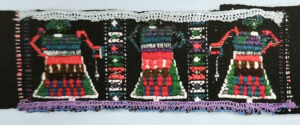
The reduced and geometrized figure has its model in woven garments, where the structure of weaving inevitably simplifies form into basic shapes. The trapezoid, the most prevalent motif, is in fact a shape that introduces movement – the element of the circle, which is impossible to perfectly inscribe through the interweaving of weft and warp. There are only greater or lesser approximations, depending on the complexity of the pattern or the skill of the hand that guides it.
Whether it is a matter of insufficiently skilled mimesis, conditioned by technique, or of deliberate abstraction – before us are records that have been encoded in patterns, motifs, and representations since ancient times. For some we sense meanings, for many we have lost the power of decipherment. The code has changed over time and acquired new meanings.
If we invoke prehistory and the cults that were fundamentally a glorification of motherhood, fertility, community, the worship of nature and its forces – earth, fire, water, and air, which form the quaternity, but also a perfect whole – then we can establish that thread in Serbian folk creativity as well, and when it comes to the anthropomorphic female figures that served as the starting point for this work.
The creative interpretation of that code, characteristic of Serbian folk creativity – in this case recorded in the heritage from the territory of Kosovo and Metohija – I have presented as three female figures-symbols, which I experience as the essential center of an archaic naive image of the world, around which our cultural heritage was built.
Girl symbolizes beauty, chastity, joy, play, the will for life.
Bride is the transformation of girl into woman, chosen to maintain the hearth, give birth, nurture, and feed.
Mother is the symbol of realized and mature fertility, warmth, self-sacrifice, courage, and the protection of life.
Archetypal representations of woman and her role, which holds an indisputable place as creator and protector, lead us to the question of whether we are still connected to the sources of our culture – land, language, existence, to our foremothers, whose lives were filled with numerous hardships and ceaseless effort to equip their children for life, projecting onto the future, from the depths of their being, forces that will protect the generation.
These figures also point to community, for without a nurturing community there would be no individuals who elevated virtue and developed community in diverse ways. That code which is transmitted, the code of collective memory, is indestructible – but it is increasingly difficult to decipher and to connect with directly. Under the burden of conformism, technology, and new social relations, we have lost connection with others and with ourselves. The loss of respect for others, whom we increasingly recognize as competitors rather than as our neighbors, leads to the loss of a sense of community and turns us into consumers of new idols imposed upon us by a brave new world.
This is an attempt to momentarily quench thirst at the purest source of folk creativity and to remind ourselves who we are and where we come from.
Model: Women's belt, 1940s, Bosce, Gornja Morava. Black wool. Woven stylized anthropomorphic doll figures and geometric motifs from woolen threads of various colors. Part of Serbian women's costume. Girl's trousseau of Stojanka Vasić.